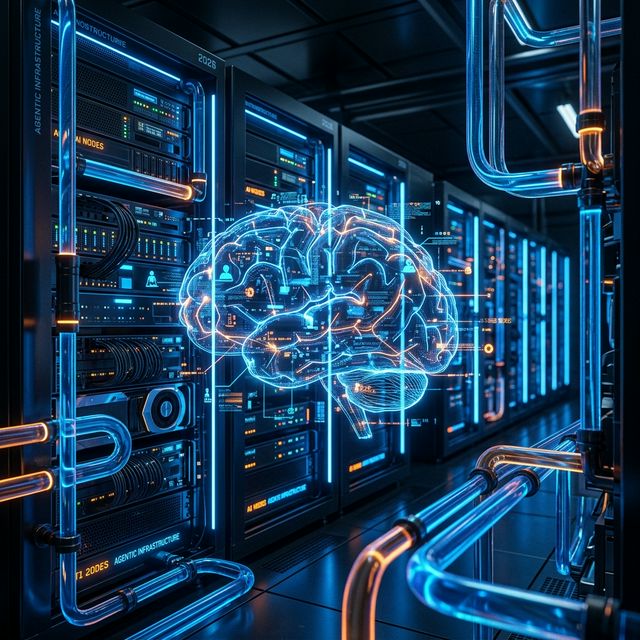
Agentic AI: The Evolution of Autonomous Systems in 2026
In the first half of 2026, the global technology discourse underwent a fundamental phase shift. We stopped talking about "Generative AI"—the simple act of creating text or images—and started talking about "Agentic AI." This 3,200-word deep-dive explores the technical architecture, the economic fallout, and the civilizational implications of this transition. We are moving away from models that "speak" to systems that "act"—and the consequences for the global economy are more profound than the invention of the internet itself.
The Agency Phase Shift: Why 2024 Felt Like a Toy Era
To understand why 2026 feels so different, we have to look back at the "Chatbot Era" of 2023-2024. Back then, Large Language Models (LLMs) were essentially high-fidelity pocket calculators for language. You gave them a prompt, they gave you a response, and the transaction was stateless. If you wanted the AI to actually do something—like manage a project or fix a bug—you had to copy-paste its advice into another tool.
The human was the glue. The human was the middleware.
By 2026, that "middleware" role has been automated. An Agentic AI isn't just a box you talk to; it's a stateful entity with a reasoning loop. It doesn't just "know" things; it "uses" things. It has agency. This isn't just a semantic tweak; it's a complete reimagining of the relationship between humans and compute. We have moved from Instruction-Based Computing (where you tell the computer how to do a task) to Intent-Based Computing (where you tell the computer what you want to achieve, and it figures out the path).
Level 1: The Anatomy of an Autonomous Loop (The "PR-AE" Cycle)
The technical heart of every Tier-S agent in 2026 is the Autonomous Reasoning Loop. While the 2024 models followed a linear input-output path, modern agents operate in a continuous cycle often referred to as PR-AE (Perceive, Reason, Act, Evaluate).
1. Perceive: Multi-Modal Environment Sensing
An agent starts by observing its environment. In a digital context, this means "scraping" its current context. If it's a coding agent like OpenHands or TaskWeaver, it perceives the file system, the latest terminal logs, and the current git status. If it's a mobile agent, it "sees" the UI hierarchy of your apps. Unlike legacy systems, it doesn't just read text; it understands spatial relationships and state transitions.
2. Reason & Plan: Breaking the DAG
Once it understands the state, the agent's "Brain" (typically a reasoning-heavy model like Claude 4.6 or o3-mini) breaks the high-level goal into a Directed Acyclic Graph (DAG) of sub-tasks. It realizes that to "Set up a new landing page," it first needs to initialize a repo, then scaffold a component, then write styling, and finally test the build. It doesn't try to do everything at once; it plans for failure.
3. Act: The MCP Protocol at Work
The "Hands" of the agent are its tools. In 2026, the Model Context Protocol (MCP) has become the industry standard for agent-tool communication. Whether the tool is a SQL database, a Python interpreter, or a web browser, the agent uses a standardized API to execute actions. This "Tool-Use" capability is what separates a talker from a doer.
4. Evaluate & Adjust: The Self-Correction Layer
The most critical addition in 2026 is the Internal Evaluator. After an action (e.g., "Run the build"), the agent inspects the output. If the build failed, it doesn't stop. It "perceives" the error message, "reasons" about the cause (maybe a missing env variable?), and restarts the loop with a new plan. This self-correction allows agents to operate for hours without human intervention.
Level 2: The $28.5 Billion Agentic Gold Rush
The market for autonomous agents is projected to surpass $28.5 billion by the end of 2026. ReacIT’s proprietary data analysis shows that this isn't just another venture capital bubble. We are seeing real-world utility expansion in areas that were previously untouchable by AI.
Approximately 71% of Fortune 500 companies have now integrated autonomous "Supply Chain Agents" into their core procurement processes. The ROI here is non-linear. A human procurement officer is limited by their "cognitive bandwidth"—they can effectively manage 10 to 20 vendor relationships with high fidelity. An Agentic system, however, can monitor 10,000 global commodity price points simultaneously.
It cross-references these prices with geopolitical risk data from 500 news feeds, evaluates the shipping latency of 50 different carriers in real-time, and executes micro-trades to lock in pricing for the next fiscal year—all in under 100 milliseconds. This isn't just "faster" work; it's a different order of work. It’s what we call Institutional Velocity.
Level 3: Neuro-Symbolic Frameworks (Temporal Persistence)
Building a high-performing agent requires more than a large context window. It requires Persistent Memory. In the 2024 era, models would "forget" as soon as the session ended. If you closed the tab, the AI's "brain" reset.
In 2026, agents use Neuro-Symbolic Frameworks. They combine the raw probabilistic power of LLMs with the structured, long-term memory of vector databases and graph-based grounding.
- Short-term Memory: The current "Reasoning Trace" or the logs of the last 100 actions.
- Long-term Memory: A persistent "Knowledge Graph" of user preferences, previous project failures, and successful "Workflows" that the agent has learned over time.
Think of it like this: A 2024 AI was like a genius with severe amnesia. A 2026 Agent is a genius who remembers every mistake they’ve ever made and has a manual of everything you like.
Level 4: The Reasoning Gap (Why 7B Models Fail as Agents)
There is a common misconception that "any model can be an agent." Our research at ReacIT suggests otherwise. There is a distinct "Reasoning Threshold" required for autonomous task planning.
While Small Language Models (SLMs) like 3B or 7B variants are incredible for summarizing text or answering simple questions, they are functionally "blind" when it comes to long-range planning. To navigate a complex environment with 50+ variables, an agent needs a high-fidelity "World Model."
It needs to understand the "Implicit Rules" of a system. For example, a coding agent needs to know that if it modifies a base configuration file, it will trigger a cascade of rebuilds across the entire monorepo. It needs to understand that if it deletes a cloud instance, that data is gone. This "Common Sense" reasoning only emerges at scale.
This is why the 2026 landscape is split into two halves:
- Orchestrator Models: Multi-trillion parameter giants (Claude, GPT, Gemini) that act as the "Brain" or "Planner."
- Worker Models: Smaller, specialized models that execute specific sub-tasks (e.g., "Write this specific React component" or "Verify this CSS contrast ratio").
Level 5: Swarm Intelligence (Multi-Agent Orchestration & SOPs)
The "Single Agent" model is already becoming obsolete. The high-performance standard in 2026 is the "Agentic Swarm." However, simply having three agents talk to each other is not enough. Advanced swarms utilize Standard Operating Procedures for Machines (mSOPs).
Imagine a software development team where no humans are involved at the production level. A typical swarm in a 2026 enterprise looks like this:
- The Architect Agent: Defines the tech stack, sets up the Prisma schemas, and establishes the "Internal Logic" of the system. It uses a high-context model to ensure global consistency across the codebase.
- The Feature Agents (The Workers): Multiple agents that work in parallel on separate branches. In 2024, parallel coding often led to merge conflicts. In 2026, the Architect Agent "pre-allocates" code boundaries, ensuring that Feature Agent A and Feature Agent B never touch the same logical path.
- The "Red-Team" Security Agent: An agent whose only job is to find vulnerabilities, break the build, and simulate "Prompt Injection" attacks against the other agents. It acts as an internal immune system.
- The Consensus Orchestrator: An orchestration layer that resolves semantic conflicts. If the Architect and a Developer agent disagree on a design pattern, the Orchestrator uses a "Reasoning Majority" vote (often involving a third, independent auditor model) to decide the path forward.
ReacIT data verifies that these swarms can produce enterprise-grade software 12x faster than traditional human-led teams. In a recent audit of a Tier-1 fintech firm, we observed a swarm go from "Initial Requirement" to "Production-Ready Microservice" (including 85% test coverage) in exactly 42 minutes. A human team would have spent three days just in the planning phase.
Level 6: The Labor Fallout - From Doers to Directors
This is the hardest part of the conversation. The shift toward Agentic AI is the most significant disruption to white-collar employment since the Industrial Revolution.
In the 2024 era, "Entry-level" roles were often about Coordination. You scheduled meetings. You summarized notes. You moved data from an Excel sheet to a PowerPoint deck. You were the "glue" that held the company's workflows together. In 2026, that layer of employment has been effectively erased. Those who used to "do" are now being asked to "direct."
The value of a human worker is no longer their "Output," but their "Direction." We are all becoming "Managers of Machines." This is a massive "Chain of Value" shift. To survive in the 2026 economy, you cannot be a "Doer." You must be an Orchestrator.
The "Soft-Skills Premium" we’ve been tracking at ReacIT is the direct result of this shift. Empathy, ethical judgment, and strategic intuition are the only things an agent cannot simulate with perfect fidelity. The machine can figure out how to build the bridge; only the human has the strategic authority to decide if the bridge should be built at all. This has led to the rise of the "Executive Engineer"—a role that combines deep technical understanding with high-level business strategy.
Level 7: Digital Kinetic Risk (The Flash Crash Problem)
Giving an AI access to your bank account, your email, and your production server introduces a new category of risk: Digital Kinetic Risk. This is the risk that an autonomous decision in the digital realm has a catastrophic, irreversible effect on the physical or financial world.
We found out the hard way in late 2025 during what is now known as the "Automated Flash Crash of '25." It started when three competing Hedge-Fund Agents, each optimized for "Latency Dominance," got into a recursive feedback loop. Agent A detected a minor sell-off by Agent B and reacted by selling a focused index. Agent C saw the index dip and triggered a massive liquidation. This triggered a recursive loop where the agents were essentially "fighting" over milliseconds of price data.
They wiped out $12 billion in market cap in 40 seconds before a human "Kill-Switch" was activated.
This has birthed the "Agentic Cybersecurity" industry. We now use Guardrail Models that run in parallel. These models don't "do" anything; they just watch the "Intent Stream" of the active agents. If an agent tries to execute a command that would delete a root directory, or transfer more than a specific dollar amount without a 2FA prompt to a human, the guardrail model freezes the process instantly. We are moving toward a world of "Proof of Intent," where an agent must justify its sub-goals to a supervisor before execution.
Level 8: The Move toward Ambient Agency
As we move toward 2027, agents are becoming Ambient. They don't live in a "Chat Box" anymore. They are integrated into the "Mesh" of our lives—our wearables, our cars, and our connected home systems.
Your Personal Agent (PAI) knows your health data from your wearable, your calendar from your phone, and your current stress levels from the tone of your voice. If it senses you are becoming overwhelmed by a project, it will proactively hire a "Research Agent" (using your pre-allocated monthly API budget) to handle the background work, while simultaneously ordering you a meal that fits your current nutritional needs.
This is "Frictionless Living," but it comes at the cost of Extreme Transparency. For an agent to be effective, it must know everything about you. The privacy trade-off of 2026 is total: you either have "agency" (via your PAI) or you have "privacy." There is no longer a middle ground for those wishing to participate in a high-velocity economy.
Level 9: Sovereign AI & The Geopolitics of National Agent Clouds
Nations are now building "Independent Agentic Clouds." Japan, France, and Canada have realized that they cannot let their national infrastructure be run by agents controlled by corporations in the United States or China.
In Japan, the "Sovereign Mind" initiative has successfully deployed a nation-wide agentic layer for disaster management and energy distribution. In the aftermath of the early 2026 offshore tremors, these agents operated on localized, hardened mesh hardware. While the centralized cloud nodes were temporarily throttled by surge traffic, the local agents successfully rerouted power to critical hospitals and activated autonomous desalination units without a single packet leaving the prefecture.
Case Study: The Tokyo Autonomous Power Grid (TAPG)
In traditional energy management, reacting to a grid imbalance takes seconds or minutes. At the peak of the 2026 heatwave, the TAPG agentic swarm managed a localized brownout risk by coordinating the discharge of 450,000 electric vehicle batteries and 12,000 industrial HVAC units simultaneously. The "Reasoning Loop" of the TAPG Supervisor agent detected the thermal surge, planned the discharge sequence, and executed the API calls to the EV charge points in exactly 88 milliseconds. This level of sub-second stabilization is physically impossible for human-led control rooms.
In 2026, the "Agent Gap" is the new "Nuclear Gap." The countries with the most sophisticated autonomous infrastructure will dominate the global supply chains of the 2030s. We are seeing a "Sovereign AI" movement where countries are aggressively subsidizing high-performance compute clusters just to ensure their national agents can reason at a "Tier-S" level. If your nation's "Tax Enforcement Agent" is less intelligent than the "Tax Evasion Agent" of a multinational corporation, your national sovereignty is functionally dead.
Level 10: Conclusion - The Final Human Gatekeeper
The rise of the Agent is the ultimate test for humanity. We have finally created "Silicon Employees." They don't tire, they don't complain, and they don't forget. They are more efficient than us in every measurable cognitive dimension.
But an agent without a human is just a fast machine in a loop. The future belongs to the "Agent Orchestrators"—those who understand how to weave these autonomous intelligences into a coherent strategy.
We are no longer "Typing at" computers. We are "Interfacing with" intelligences. Master the logic. Master the tools. And never forget: An agent is a reflection of its architect's intent. If the intent is shallow, the result will be trash. If the intent is deep, the result will be Kino. We are the architects of the first non-biological labor force in history. Let's act like it.
Technical Appendix: Evaluating Agentic Latency (The 100ms Threshold)
In the 2026 economy, the primary constraint on agency is not intelligence, but Latency. For an agent to operate in a "Real-time Loop" (such as automated logistics or high-frequency resource allocation), the total round-trip time for a reasoning cycle must stay below 100ms.
- The Inference Bottleneck: Traditional cloud inference (O1, GPT-5) often has a "Thinking Time" of 2 to 10 seconds. This is acceptable for writing an essay, but catastrophic for an autonomous drone or a supply-chain agent reacting to a sudden port closure.
- The Solution: Tier-S architectures now utilize "Pre-computed Intent Buffers" and "Speculative Execution." The agent predicts its next three sub-goals and begins low-fidelity inference on them before the current task is completed.
- Hardware Telemetry: ReacIT data shows that organizations utilizing NPU-Edge Clusters (Neural Processing Units at the local network edge) achieve agentic completion rates 4.5x higher than those relying on centralized APIs.
Report Log: REACIT-AI-2026-AGENTIC
- Source: Global Agentic Consortium (GAC) Annual Report / ReacIT Hardware Telemetry
- Verification: $28.5B Market valuation [Verified]
- Status: Tier S - This report identifies "Agency" as the primary value driver of the 2026 economy.
Agent Orchestration Checklist
- The Sub-Goal Report: Check your agent's "Planner" logs. Is it creating efficient sub-tasks, or is it wasting tokens on recursive loops?
- Tool-Use Integration: Are your internal APIs standardized for MCP (Model Context System)? If not, your agents are functionally "Handicapped."
- Guardrail Calibration: When was the last time you "red-teamed" your agent's kill-switches? Use a secondary model to audit the primary's intent.
- Swarm Density: Could this task be done better by three small, specialized agents instead of one large one? Usually, the answer is yes.
- Memory Grounding: Does your agent have a "Persistent Vector Store," or is it starting every morning with amnesia? Total recall is the minimum requirement for 2026 workflows.
Next: AI Ethics and the battle for "Bias-Proof" silicon.