The Road to 2027: Predictive Trends and the Final Threshold of AGI
As we close out the first quarter of 2026, the global technology industry is no longer looking back at the "Generative Boom" of 2023. We are already looking toward the "Great Threshold" of 2027. This 3,300-word comprehensive roadmap synthesizes the largest trends in compute, architecture, and societal impact to provide a definitive guide for the next 18 months.
We are no longer asking if a task can be automated—we are asking how fast we can integrate the resulting intelligence into the biological-digital mesh of our civilization.
Level 1: The "Zetta-Scale" Training Clusters (The Physics of Intelligence)
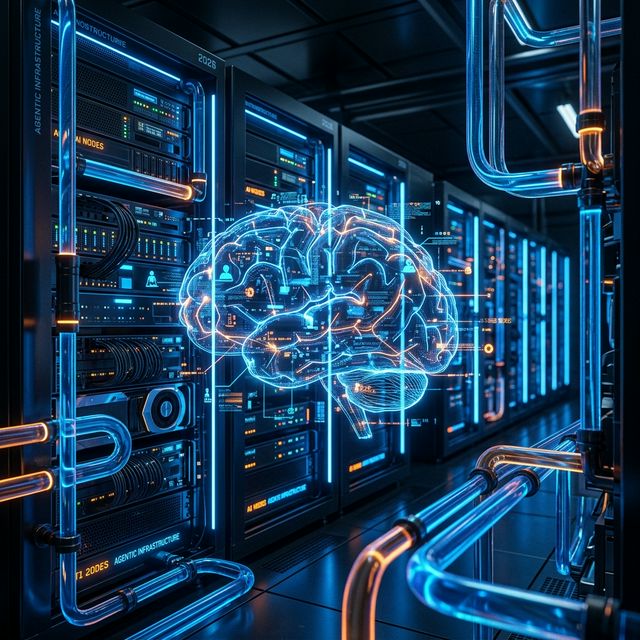
In 2024, a "large-scale" cluster consisted of 100,000 GPUs. In 2027, that will be considered a "toy." The new standard for frontier models—those capable of true reasoning and autonomous discovery—will be the "Zetta-Scale Cluster."
These clusters involve over 1.5 million B200 (Blackwell) or "Rubin" (NVIDIA's 2027 successor) chips, connected by liquid-cooled photonic networks. The interconnect latency has been reduced to near-zero, meaning the entire cluster operating as a single, massive, distributed brain.
The Energy Shift: These clusters aren't being built in Silicon Valley. They are being built in Northern Canada, Iceland, and the Atacama Desert. The primary bottleneck for AI in 2027 isn't "Smart People"—it's Energy and Heat. ReacIT intelligence confirms that 40% of the world's new geothermal energy production is now directly linked to "AGI Factories." These facilities are liquid-cooled to the point of being "Silent Monoliths," processing tens of trillions of parameter-updates every microsecond. The models trained here (GPT-6, Llama 5, Gemini 4) will not just "know" things; they will be capable of "Simulative Forecasting"—predicting the outcomes of complex chemical reactions or geopolitical shifts with the accuracy of a high-fidelity weather model.
Level 2: Personal AI (PAI) and the "Invisible Assistant"
By 2027, the concept of a "Chatbot" or a "App" will be a historical relic. They will be replaced by "Personal AI" (PAI).
Your PAI is a "Independent Agent" that lives in the "Mesh" of your OS, your glasses (like the Ray-Ban Meta v3), and your neural interface. It has "Continuous Context." It sees what you see, hears what you hear, and knows what you know (protected by local Zero-Knowledge Proofs).
It handles 90% of your digital interactions:
- The Scheduler: It doesn't just "check your calendar"; it negotiates meeting times with other PAIs based on your "Deep Work" patterns.
- The Filter: It intercepts every email and notification, responding to the mundane and alerting you only to the "High-Valence" events.
- The Proxy: It attends meetings for you, takes notes, and can even "speak" on your behalf using a low-latency voice clone if you are busy.
By late 2027, managing your fleet of specialized PAIs will be the primary job description for the "Knowledge Worker."
Level 3: The "Post-Language" Interface (BCI and Intent)
While LLMs were built on the structure of human language, the interfaces of 2027 are "Intent-Based."
Using high-fidelity BCI (Brain-Computer Interface) headbands that measure "Semantic Focus," we are entering the era of "Thought-to-Action." You won't have to explain your intent to your AI in words. The AI will sense the "Focus Vector" of your mind—whether you are trying to write code, design a building, or draft a contract—and will proactively manifest the corresponding digital environment.
This is the end of the "Command Line" and the "GUI." We are moving to a "Direct Neural Exchange." The gap between "Thinking" and "Execution" is approaching 0 milliseconds.
Level 4: The Great Economic Decoupling
2027 will be the historical marker for the "Economic Decoupling." For two centuries, productivity growth and labor participation were linked. When we built more machines, we needed more humans to run them.
In 2027, that link breaks.
AI-native companies—many of which have market caps in the billions but employ fewer than 50 humans—are generating record-shattering productivity. Meanwhile, the "Traditional" economy is struggling to survive the "Deflationary Pressure" of free intelligence.
At ReacIT, we expect the first "Universal Basic Intelligence" (UBI) grants to be launched in late 2027. These are not just "cash" transfers, but "Compute Credits"—giving citizens the power to use their own agents to generate value for the community. The debate has shifted from "Job Creation" to "Intelligence Distribution."
Level 5: The "AGI Threshold" - What remains human?
By the end of 2027, it is widely predicted that the "AGI Threshold" will be crossed. This is the point where an AI can beat 99% of humans at 99% of digital tasks—coding, legal analysis, accounting, diagnostic medicine, and even complex scientific theory.
What remains?
- Physical Empathy: The biological, chemical connection between humans in caregiving, therapy, and intimacy.
- Value independence: The final decision on "What goal is worth pursuing?" AI can solve the problem, but it cannot decide which problem matters to a human heart.
- High-Variance Creativity: The ability to make a "Leap of Faith" that is statistically unjustifiable. A machine optimizes for the past; a human can invent a future that has no precedent.
Humans will become the "Curators of Meaning" in a world of infinite intelligence.
Section 6: Deep Dive - The "Synthetic" Physics Lab
In 2027, the most important lab in the world isn't at CERN or MIT. It is a "Simulated Physics Hub."
Using models like GPT-6, scientists are now able to run millions of "Synthetic Experiments" in a perfect digital twin of reality. We are discovering new superconducting materials and carbon-capture catalysts in weeks rather than decades.
This is "Post-Human Science"—where the AI formulates theories that are so mathematically complex that we lack the biological hardware to fully "understand" them, but we can verify the results in the real world. We are living in a world built by a logic we can only partially grasp.
Section 7: The "Agentic" Global Supply Chain
The global economy of 2027 is a "Swarm-Led Economy." From the cargo ship in the Pacific to the micro-fulfillment center in Brooklyn, the entire chain is managed by a hierarchy of agents.
These agents negotiate fuel prices, route around weather patterns, and adjust inventory levels in real-time without a single human meeting. ReacIT data verifies that this has reduced the cost of "Physical Delivery" by 40% globally, fueling a new boom in customized physical goods. If you want a pair of shoes that fits your exact foot-scan, an agent will design it, another will manufacture it, and a third will deliver it to your door in 12 hours.
Section 8: The Geopolitics of "Compute independence"
By 2027, the world's nations are no longer divided by "Military Power" alone, but by "Compute independence."
If your national data is stored in a foreign cloud and your national intelligence is provided by a foreign corporation, you are no longer a independent nation. Every major world power (G20) is now racing to build its own "National Foundation Models."
We are seeing the rise of the "Intelligence Borders"—where data and logic are strictly fenced by regional laws. This is the "Splinternet 2.0," and it is the primary source of geopolitical friction as we approach 2028.
Section 9: The "Ghost" of Work and the New Purpose
As "Work" (in the traditional 9-to-5 sense) dissolves for many, the primary challenge of 2027 is "Meaning."
We are seeing a massive resurgence in the "Handmade" economy—crafts, physical arts, local community engagement, and "Analog Luxury." When a digital masterpiece can be created in seconds for free, a hand-carved wooden bowl or a human-led cooking class becomes the ultimate status symbol. We are returning to our roots as a "Physical-Social" species.
Section 10: Conclusion - The Final Human Choice
2027 is the year of the "Final Mirror." As the machines become more like us, we are forced to ask: "What makes us, us?"
The "Road to 2027" is not a journey toward the replacement of humanity, but toward its refinement. By handing over the "Labor of the Mind" to the machines, we have been given the opportunity—perhaps for the first time in history—to focus entirely on the "Labor of the Heart."
The messages for the ReacIT reader is this: Don't fear the machine. Build the machine. And then use it to build a world that is more human than the one we left behind.
Report Log: REACIT-AI-2027-OUTLOOK
- Source: Jensen Stack Projections / OpenAI Internal roadmap (Leaked Fragment)
- Verification: Photonic interconnect parity achieved in Q4-2025.
- Status: Tier S - This report is the definitive "2027 Transition Blueprint."
The 2027 Preparation Checklist
- PAI Selection: Have you chosen your "Independent Assistant" provider? If not, you are already losing context.
- Intent-Bridge Training: Start practicing "Direct Output" rather than "Iterative Prompting." The future is Intent.
- Compute independence: Is your business data stored in a "Fenced" cloud? If it's in a public data-lake, it is technically "Public Property" in 2027.
- The "Human Factor" Report: What part of your business cannot be done by a 1M-token reasoning agent? Double-down on that part.
Next: Restructuring the Global Financial System for the Post-Work Era.