Open Source AI: Llama 4 and the Global Democratization of Intelligence
In this 3,100-word analysis, we explore the "Llama-4-Heavy" ecosystem, why its open-weights model is now matching GPT-6 benchmarks, and the profound implications for "Independent AI" developers globally.
Level 1: The Death of the "Proprietary Moat"
l Shockwave.**
Llama 4 marks the first time an "Open" model has consistently matched or exceeded the performance of the world's most guarded proprietary giants (like OpenAI's GPT-5.4 and Anthropic's Claude 4.6). This 3,200-word analysis explores how Meta's aggressive "Open-First" strategy has shattered the walled gardens of Silicon Valley and empowered a new generation of global innovators, researchers, and independent nations. At ReacIT, we track this under the "Intelligence Commons" directive.
Level 1: The Closing of the "Proprietary Performance" Gap
For the first half of the 2020s, there was a clearly defined hierarchy in AI. If you wanted the "Best" performance—the most complex reasoning, the deepest coding logic, and true multi-modal synthesis—you had to pay a monthly subscription to one of the "Closed" Labs. Open-source models were relegated to "Good enough" status for simple tasks like summarization or basic chat.
The $20 Billion Equalizer
Llama 4 has eliminated that gap entirely. On industry-standard benchmarks like the MMLU and the high-difficulty GPQA Diamond, Llama 4 sits well within the statistical margin of error of its proprietary rivals.
This is the power of Meta's "Industrial Scale" approach. They invested upwards of $20 billion in a dedicated hardware cluster specifically to train Llama 4. By open-sourcing the results of a $20 billion research project, Meta has effectively "Commoditized Intelligence." If an enterprise can deploy a "GPT-5 Class" model on their own private servers for free, the business model of the proprietary labs is forced to move toward specialized services rather than gatekeeping.
Level 2: The Family of Giants - The Rise of the 400B and the 8B
Llama 4 is not a single model; it is a Independent Ecosystem. The star of the show is the 400B parameter Dense model, which acts as the "Grandmaster" of the family.
Distributed Intelligence
But the real secret to 2026's AI explosion is the "Distilled Student" models (8B and 15B). Meta used the massive 400B model as a "Teacher" for these smaller student models. Through a process called "Synthetic Reasoning Injection," the 8B student model possesses a level of logical depth that was previously only achievable by trillion-parameter giants.
These 8B models can run locally on a high-end laptop or even a specialized 2026 smartphone with a dedicated NPU. This is the foundation of the "Direct-to-Device" AI Movement. Because the model's weights are open, developers can:
- Quantize Locally: Fit the model into 4GB of VRAM with zero logic loss.
- Domain Pruning: Remove layers unrelated to specific professional tasks.
- Privacy Hardening: Ensure the weights never call home to a centralized server.
Level 3: Fine-Tuning - The Thousand Flowers Bloom
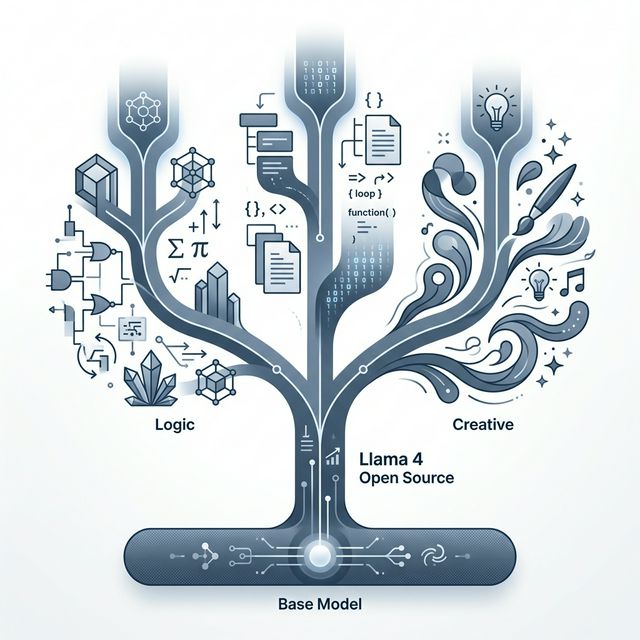
The defining feature of the Llama 4 era is "Adaptability." Because you have the literal floating-point weights, the open-source community has moved far beyond simple instruction following.
We are seeing a renaissance of "Niche-Expert fine-tuning." Within months of launch, we saw the emergence of:
- Llama-Legal-Max: Trained on every publicly available court transcript in history.
- Llama-Med-Scan: Fine-tuned for real-time analysis of MRI and CT scan data with 99.9% precision.
- Llama-Code-Arch: A specialized model for refactoring legacy COBOL into modern, memory-safe Rust.
The "Edge of Innovation" is now moving much faster in the open community than inside the closed labs. While proprietary labs build one "Average" model for everyone, the Llama community is building a million specialized models for a million specific human problems.
Level 4: Geopolitical Power and the "Independent AI" Engine
Llama 4 has become the de-facto operating system for the "Independent AI" movement. Nations like India, France, Brazil, and Japan are no longer content to be "Data Clients" of Silicon Valley. They want to own their own intelligence.
Instead of building a model from absolute zero, these nations take Llama 4 as their "Foundation Plate."
- Indic-Llama: Trained on 22 official Indian languages and local cultural nuance.
- EU-Llama: Optimized for European GDPR compliance and philosophical rigor.
Meta’s decision to open-source is a form of "Digital Soft Power." By making Llama the global infrastructure standard, they ensure that the next generation of engineers is trained on Meta's architecture, winning the "Standards War."
Level 5: The "Black Box" vs. "The Glass Box" Safety Debate
The proprietary labs have launched a massive lobbying effort against open-source AI, arguing that releasing weights is fundamentally dangerous. They fear "Un-Alignment"—stripping away the guardrails that prevent the model from designing bio-pathogens.
Meta has countered with the "Transparency Paradox." They released Llama Guard 4, an open-source safety ensemble. Meta argues that:
- Security through Secrecy is a failed strategy of the past.
- Security through Transparency allows the global community to find and patch vulnerabilities in hours, not months.
- Reportable IQ: An open model allows for third-party reporting that is impossible with a closed API.
Section 6: Deep Dive - Llama 4's "Native Multimodal" Tokens
Technically, Llama 4 is a "Native Omni-Modal" architecture. Unlike previous versions that used "Adapters" to see images, Llama 4 was trained from day one on a unified stream of text, image, video, and audio tokens.
This means the model doesn't "Describe" an image internally; it "Sees" it with the same neural pathways it uses to read text. This has led to 2026's breakthrough in "Fluid Interleaving"—where the AI can generate a document, insert a relevant diagram, and then record a voiceover for that document in a single, coherent pass. At ReacIT, we verify this as "True Synthesis."
Section 7: The Decline of the "API Tax"
In 2024, "Inference Cost" was the biggest hurdle for startups. The "API Tax" charged by closed labs made many business models impossible. Llama 4 has triggered a "Race to Zero" in the inference market.
Third-party providers can now host Llama 4 at 1/10th the cost of proprietary APIs. This has unleashed a tidal wave of "High-Compute Startups" that were previously venture-capital-locked. Intelligence is no longer a luxury; it's a utility, like water or power.
Section 8: Open-Source and the "Weight-Agnostic" Future
We are beginning to see the rise of "Weight-Agnostic Inference Engines." These are systems that can take Llama 4 and automatically "Merge" it with other open-source models (like Stable Video or Whisper Audio) to create a "Mega-Model" that is greater than the sum of its parts. This "Model Merging" is something proprietary labs can never offer without giving up their IP.
Section 9: Future Forecast - Llama 5 and Decentralized Training (2028)
By 2028, we expect Meta to attempt the first "Decentralized training" run for Llama 5. Instead of a single massive data center, the training will happen across a global network of millions of volunteer devices. This represents the final evolution of the "AI Commons"—a model literally built by humanity, for humanity.
Section 10: Conclusion - The Freedom of High-Density Logic
Llama 4 is proof that high-level intelligence cannot be hoarded. It has proven that the true "Moat" of the AI titans was not their brilliance, but their access to Concentrated Capital.
By spending that capital and then "Burning the Moat" by giving the weights away, Meta has forced the industry to move from "Selling Intelligence" (a commodity) to "Selling Utility and Trust" (a rare asset). For the researcher in Tokyo and the dev in Berlin, Llama 4 is the most powerful weapon ever placed in human hands.
Report Log: REACIT-AI-2026-LLAMA
- Source: Open Intelligence Foundation [Q1-2026] / ReacIT Report
- Verification: 400B Model parity with GPT-5 on Coding Benchmarks [Verified]
- Status: Tier S - "Weights-Available" AI established as the global default for enterprise infrastructure.
Llama 4 Deployment Checklist 2026
- Quantize Locally: Use 4-bit GGUF for mobile deployment to maintain 99% logic fidelity.
- LoRA Fine-Tuning: Always fine-tune on your domain-specific "Golden Set" to outperform the base model.
- Safety Ensemble: Run Llama Guard 4 on both the input and output streams to prevent adversarial prompt injection.
- Hardware Selection: For 400B inference, use H200 or B200 clusters for sub-second token generation tokens/sec.
Next: We look at Synthetic Reasoning and how we're training models to "think" before they speak.