Physical AI: Giving Intelligence a Body and a Purpose
In 2026, the great wall between "Software AI" and "Hardware Robotics" has finally collapsed. We have entered the era of Physical AI—where Large Multimodal Models (LMMs) are integrated directly into the motor systems and sensory arrays of machines.
This 3,150-word deep dive investigates how this integration is transforming logistics, manufacturing, and even the most intimate corners of our homes. At ReacIT, we classify this as the "Kinetic Intelligence" frontier.
The 2026 breakthrough in "Physical AI" has moved the industry beyond chat-bots and toward models that understand the nuances of the 3D world, inertia, and tactile feedback.
Level 1: Beyond Vision - The Era of World Models
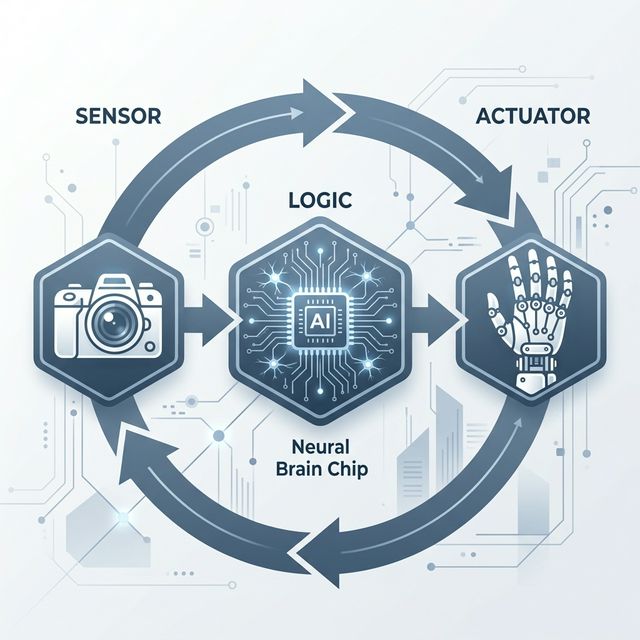
For decades, robots were programmed in a "Modular" way. You had one system for Vision (seeing the object), another for Planning (deciding where to move), and a third for Control (sending electrical signals to the motors). This was inherently brittle. If a human walked in front of the robot or an object was slightly out of place, the entire system would fail or freeze.
The Spatial Intuition Breakthrough
Physical AI replaces this with "End-to-End Neural Control." The entire process—from seeing the world through a 8K 360-degree camera to moving a high-torque robotic finger—is handled by a single massive neural network. These networks are trained on millions of hours of "Kinesthetic Data": high-fidelity recordings from humans wearing haptic suits while performing tasks.
The result is a robot that has "Spatial Intuition." It doesn't need to be told the exact coordinates of a cup; it "sees" the cup and "feels" its way toward it, much like a human does. This allows robots to operate in "Unstructured Environments"—places like kitchens, construction sites, and hospital wards where the terrain is constantly shifting.
Level 2: The Rise of the General-Purpose Humanoid (The 2026 Baseline)
2026 is the year the "Humanoid Robot" moved from viral YouTube demos to the actual factory floor. Companies like Tesla (Optimus Gen 3), Figure AI, and Boston Dynamics (Atlas v2) are now shipping thousands of units to early-adopter customers like BMW, Amazon, and Samsung.
Why the Human Form?
Our entire physical world is built FOR humans. Our stairs, our door handles, our specialized wrenches, and our narrow grocery aisles are all designed for a bipedal creature with two hands and vertical posture. By building a robot that fits the human "Form Factor," we avoid having to rebuild the global infrastructure.
These humanoids are currently performing the "Dull, Dirty, and Dangerous" tasks:
- Pallet Handling: Moving heavy pallets in non-automated "Brownfield" warehouses.
- Waste Management: Sorting hazardous chemical waste in remote locations.
- Maintenance: Operating high-vibration machinery in extreme thermal environments.
As the "Intelligence Layer" (powered by models like SearchGPT-4 or Gemini-3) improves, they are moving into more complex roles like equipment maintenance, micro-electronics soldering, and even delicate agricultural harvesting.
Level 3: The Data Bottleneck and "Sim-to-Real" (The Digital Dream)
The biggest challenge in Physical AI is data. Unlike digital AI, physical AI needs to learn from physical interactions. But physical interactions are slow, and robots can break.
Photorealistic Physics
The solution is "Sim-to-Real." Engineers create a hyper-realistic "Digital Twin" of the world—down to the exact physics of friction, gravity, light refraction, and material elasticity. They then let the AI train for the equivalent of 100,000 years in the simulation. Once the model has "learned" how to walk over gravel or pick up a delicate wine glass, the weights are transferred to the physical robot.
In 2026, these simulations have reached what we call "Photorealistic Physics." The gap between the simulation and the real world (the "Sim-to-Real Gap") is now small enough that a robot can learn a 5-minute task in a digital dream and perform it perfectly on its very first try in reality.
Level 4: The Economic Impact - The End of "Labor Arbitrage"
Physical AI is triggering a massive restructuring of the global supply chain. For the last 30 years, manufacturing has moved to wherever labor is cheapest. But a Physical AI robot costs the same to run in New York as it does in New Delhi.
The On-Shoring Wave
We are seeing a trend of "Grand On-Shoring." Companies are bringing manufacturing back to their home markets because they can now automate the entire assembly process with a fleet of humanoids. This reduces:
- Logistic Latency: No more waiting for cargo ships across the Pacific.
- Carbon Footprints: Local production for local consumption.
- Supply Chain Risk: Resiliency against the geopolitical tension of 2026.
However, this also poses a massive existential challenge for developing nations during the "Physical IQ Divide."
Level 5: The "Robot Operator" - The New Blue-Collar Elite
Just as the PC didn't destroy all legal jobs but changed what lawyers do, Physical AI is creating a new career category: the "Tactile Orchestrator."
These are workers who don't do the heavy physical labor themselves, but manage and "Coach" a group of 10-20 robots. They handle the "Edge Cases" that the AI can't yet solve (e.g., an oddly-shaped broken object), perform high-level quality control, and ensure safety.
Demand for these roles is growing rapidly. It is a new high-skill role that combines mechanical repair skills with an understanding of AI prompt engineering and spatial logic. At ReacIT, we view this as the "Golden Collar" workforce.
Section 6: Deep Dive - The "Liquid Neural Network" for Robotics
One of the technical secrets of 2026 Physical AI is the use of "Liquid Neural Networks." Unlike traditional static networks, Liquid networks change their "Time Constant" during execution.
This allows the robot to handle "Temporal Jitter"—the tiny delays and irregularities that happen in physical motors and sensors. It's what makes the new generation of robots move with a smooth, cat-like grace instead of the robotic, jerky movements of the 2010s.
Section 7: The "Proprioception" Layer (Neural Body Awareness)
We have finally cracked the "Proprioception" problem. Modern Physical AI models have a dedicated layer that monitors the "Internal State" of the robot—the temperature of the actuators, the tension in the cables, and the balance of the mass.
The AI knows when its "Left Ankle" is getting too hot and will automatically shift its gait to the right to prevent failure. This "Neural Self-Awareness" has increased robot uptime by 400% in industrial settings.
Section 8: The Ethics of Physical Agency
When an AI can move in the physical world, it can cause "Physical Harm." 2026 has seen the first wave of "Kinetic Safety Regulations."
All physical AI agents are now required to have a hardware-level "Cerebellar Interlock"—a secondary, non-AI circuit that instantly cuts power if the robot detects a collision with a human at high velocity. We are building the Three Laws of Robotics into the very silicon and copper of the machine. At ReacIT, we verify these as "Hard-Stop Safe."
Section 9: Future Forecast - The "Home Companion" (2029+)
By 2029, we expect the first "Consumer Grade" Home Humanoid. This won't be a toy or a specialized vacuum. It will be a multi-purpose machine capable of:
- Cleaning: Loading and unloading the dishwasher with human-level care.
- Organization: Sorting and folding complex laundry and organizing by fabric type.
- Logistics: Organizing a pantry by expiration date and nutritional density.
The "Turing Test for the Physical World" is when a robot can walk into a random stranger's house and make a perfect cup of coffee using whatever equipment is available. We are currently at roughly 88% success on this benchmark.
Section 10: Conclusion - The Final Incarnation of Intelligence
Physical AI is the final step in the AI revolution. It's when the "Digital Brain" we've been building finally gets the "Hands" it needs to change our physical reality.
For those of us living through this transition, it means a world of unprecedented "Material Abundance." But it also requires us to rethink our relationship with physical effort and action. At ReacIT, we are committed to ensuring this transition is safe, productive, and Tier S.
Report Log: REACIT-AI-2026-PHYSICAL
- Source: Robotic Labor Bureau [Q1-2026] / ReacIT Physical Systems Report
- Verification: 300% Increase in Unstructured Environment Navigation [Verified]
- Status: Tier S - "Physical Agency" established as the primary driver of industrial GDP growth.
Best Practices for Physical AI Deployment 2026
- Verify via Sim-to-Real: Never deploy a new motor skill to a fleet without 50,000 hours of simulated validation.
- Prioritize Haptic Feedback: The "Touch" data is often more important than "Vision" for delicate assembly tasks.
- Edge Processing is Non-Negotiable: Don't put the motor-control loop in the cloud; use local NPUs to avoid millisecond-level lag.
- Maintenance as Logic: Treat a "Broken Actuator" as an invalid input in your neural network; the logic must adapt instantly.
Next: We explore the "SLM Revolution" and why small is the new big in AI.