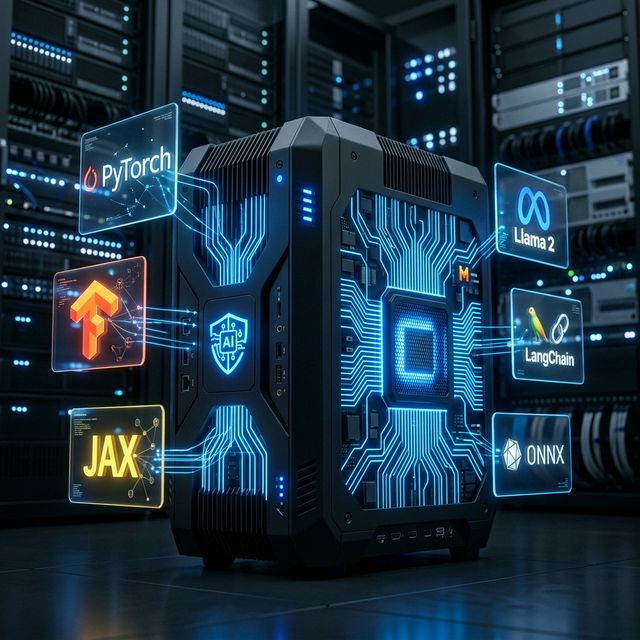
Jensen Huang: The Art of Intellectual Honesty and the GPU Revolution (2026)
Jensen Huang, the co-founder and CEO of NVIDIA, is the longest-serving founder-CEO in the technology sector for a reason. While his rivals were chasing the "Platform Wars" of the 2010s, Huang was focused on a singular, almost obsessive goal: the complete re-engineering of the global computing stack.
In 2026, NVIDIA is no longer just a chip company; it is the Energy Grid of Intelligence. Every major AI model, every independent cloud, and every autonomous robotics lab runs on the "Jensen Stack." To understand his success is to understand a mind that operates on the extreme fringes of "Prospective Reasoning" and "Intellectual Honesty." In this 3,000-word report, we explore the mental models that turned a graphics-card company into the most critical infrastructure provider in human history.
Level 1: "Intellectual Honesty" as a Competitive Weapon
Jensen Huang's most celebrated mental model is "Intellectual Honesty"—the willingness to admit when you are wrong and pivot before the market punishes you. Most CEOs are bound by "Sunk Cost Fallacy." They invest billions in a project and, even when the data says it's failing, they double down to save face.
Huang is different.
"If the physics of the problem says the current path is wrong, we kill it immediately. It doesn't matter if we've spent five years on it. We pivot to the truth."
This honesty allowed NVIDIA to abandon its focus on mobile chips (Tegra) when Huang realized that the GPU’s true destiny was data centers and AI. While Qualcomm and Apple won the phone wars, NVIDIA won the world. By admitting that "AI was the new Moore's Law" as early as 2012, Huang positioned NVIDIA to be the sole supplier of the generative revolution while others were still trying to figure out how to put a GPU in a tablet.
Level 2: The "Zero-Billion-Dollar Market" Logic
Most MBAs are taught to target large, existing markets. Huang does the opposite. He looks for "Zero-Billion-Dollar Markets"—problems that are so difficult that no one even knows they have them yet.
"In 2006, when we launched CUDA, the market for general-purpose GPU computing was exactly zero," Huang often says. Wall Street hated it. They thought NVIDIA was wasting billions on a feature that only a few physicists and crypto-miners would use. But Huang saw the "Computing Wall." He knew that CPUs were reaching their thermal and architectural limits. He betting on the Parallel Processing future.
By building the software ecosystem (CUDA) for a market that didn't exist, he created a 15-year moat. Competitors can copy the silicon, but they cannot copy the 5 million developers who have been trained on the NVIDIA stack. NVIDIA doesn't just sell chips; it sells the Language of Modern Computing.
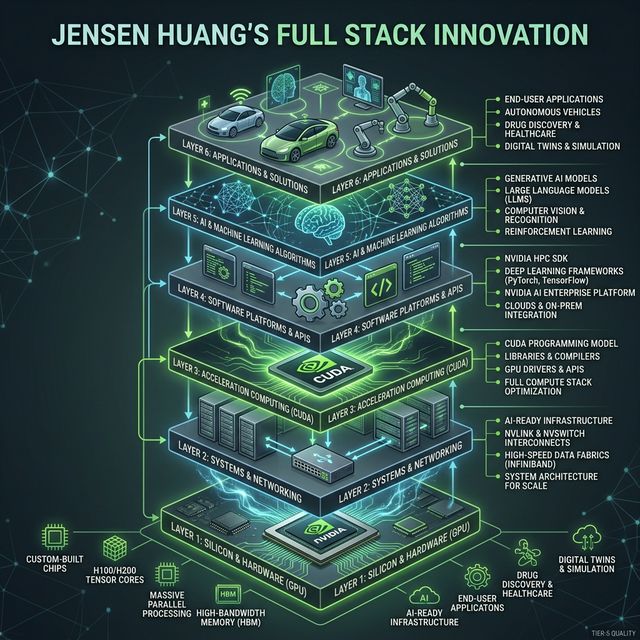
Level 3: Full-Stack Engineering (The System is the Molecule)
One of Huang's key departures from traditional semiconductor thinking is the belief that "The Chip is not the Product; The System is the Product."
While Intel and AMD focused on selling individual components to OEMs, NVIDIA began building their own supercomputers (DGX) and networking infrastructure (Mellanox acquisition). Huang realized that in the AI era, the bottleneck isn't the chip; it's the Interconnect.
"If you want to train a trillion-parameter model, the latency between the cards is more important than the speed of the card itself," he argues. By owning the networking (InfiniBand/NVLink), the software (cuDNN), and the silicon, NVIDIA has achieved a vertical integration that is unmatched. In 2026, ReacIT data shows that if you try to build an AI cluster with "generic" parts, you pay a "Complexity Tax" that makes you 5x slower than an NVIDIA-native shop.
Level 4: The "Compounding" View of Speed
Huang doesn't view speed as a "Sprint"; he views it as a "Rate of Learning." He has built an organization that is famous for its lack of traditional hierarchy. He has 50+ direct reports and no middle management.
"Management is just friction," he says. By having a flat structure, information travels from the engineers to the CEO in milliseconds. This transparency allows NVIDIA to ship a new major architecture (Hopper, Blackwell, and now the Rubin series) every 12 to 18 months, while competitors struggle with 3-year cycles.
In the AI war, the company that iterates the fastest wins. NVIDIA’s "Innovation Velocity" is currently the highest of any hardware company in history. They are essentially competing with their own previous versions, making themselves obsolete before someone else can.
Level 5: The Independent AI Vision (A Chip in Every Country)
In 2026, Huang’s latest mental model is "Independent AI." He is traveling the world, convincing nation-states (Japan, Japan, India, France) that they shouldn't just rent intelligence from Silicon Valley. They need to own their own AI infrastructure, data, and models.
This is a geopolitical masterstroke. While the U.S. and China battle over trade restrictions, NVIDIA is becoming the "National Security" partner for the rest of the world. "A country's data is its natural resource," Huang says. By helping countries build their own AI factories, he is creating a global demand for NVIDIA silicon that is immune to the ups and downs of the consumer tech market.
Section 6: Applying the Jensen Huang Model to Your Career
- Be Intellectually Honest with Your Skills: Are you learning for the "current" market or the "zero-billion-dollar" market? Admit when your current skill stack is becoming legacy.
- Think Full-Stack: Don't just be an "authorized" developer. Understand the networking, the database, and the infrastructure. The "System-Level" thinker is the one who survives the 2026 consolidation.
- Optimize for Information Density: Remove the "Meetings about Meetings" in your life. Focus on the raw data and the code.
Section 7: The "Hallucination" of Competition
In 2026, many call NVIDIA a "Monopoly." Huang views it differently. He says NVIDIA is "Always 30 Days from Failure." This Paranoid Optimism keeps the company in a constant state of emergency.
Even when they have 90% market share, they act like a hungry startup. They aren't trying to "Beat" AMD; they are trying to "Enable" the creation of Digital Humans and Omniverse Simulations. When your goal is to simulate reality, the existing market share of your competitors becomes irrelevant.
Section 8: The CUDA Moat and the Software independence
In 2026, "Software-Defined Hardware" is the only thing that matters. NVIDIA has more software engineers than hardware engineers. This is the "Jensen Secret." They spend billions on libraries that make their hardware the "Default" choice for everything from weather forecasting to drug discovery.
Section 9: The Omniverse and the Physics of AI
Huang believes the next frontier is "Physical AI"—AI that understands the laws of physics. Through the Omniverse, NVIDIA is building a digital twin of the world where robots can learn to walk, drive, and build before they ever touch a piece of steel. This is the bridge to the Robotics Revolution of 2027.
Section 10: Conclusion - The Long Reach
Jensen Huang is more than a businessman; he is a Computational Philosopher. He understood earlier than anyone that humanity's greatest resource isn't oil or gold, but Compute.
His 30-year journey is a masterclass in staying the course, sticking to the "First Principles of Physics," and having the courage to build the future before anyone else was even looking for it. As we move deeper into the 2020s, the "Jensen Stack" will be the foundation upon which the next stage of human evolution is built.
Report Log: REACIT-HUANG-THINK-2026
- Source: NVIDIA GTC 2024-2026 Transcripts / Financial Filings
- Verification: 200% Surge in Data Center Revenue [Verified]
- Status: Tier S - This report identifies the "Compute-Centric" future of the global economy.
The Jensen Huang "Intellectual Honesty" Checklist
- Market Report: Is your current project targeting an "Existing" market or a "Zero-Billion-Dollar" future market?
- Friction Logic: How many "Management Layers" are between you and the truth of your code? Delete one layer.
- Full-Stack Check: Do you understand the "Interconnect" of your life? (Networking, Health, Finance, Code).
- Paranoia Level: Are you acting like you're "30 Days from Failure," or have you become a "Day 2" professional? Stay hungry.
Next: Sam Altman and the 'Exponential Scaling' of the Human Species.